What Happens at a Sound Bath? What to Expect at Your First Session
by Kristina Silvestry, MA, NCC, LPC, ACS, CCTP, RYT-500
You saw a sound bath on a studio schedule, or a friend mentioned one, and something in you got curious.
Then another part of you piped up. What if I do it wrong? What if I can’t relax? What am I even supposed to DO there?
Both of those parts make sense. Trying something new with your body, in a room full of strangers, is vulnerable. So let’s take the mystery out of it. Here’s what actually happens at a sound bath, start to finish, so the part of you that likes to know what’s coming can settle before you ever walk in the door.
What is a sound bath, exactly?
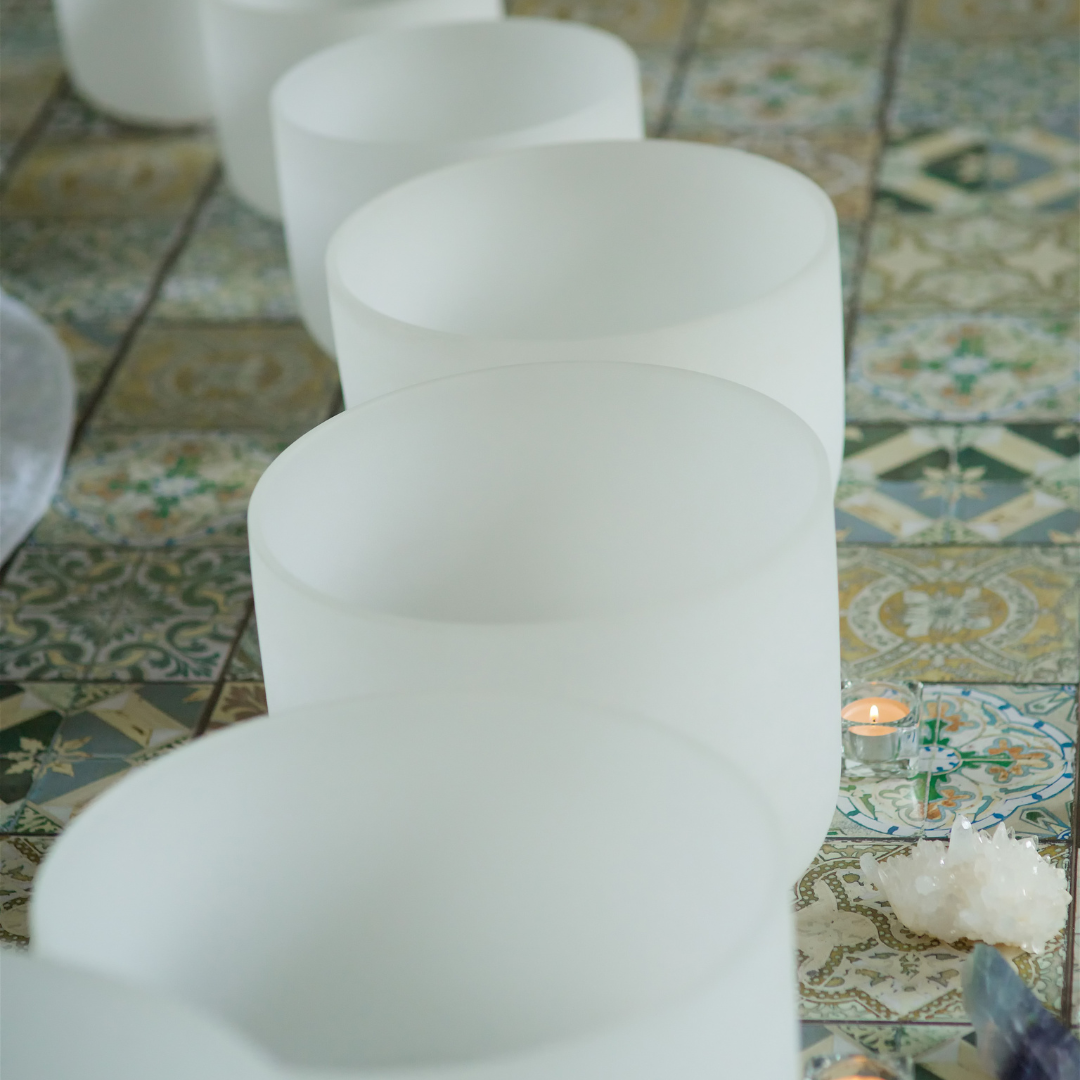
A sound bath is a meditative experience where you rest, usually lying down, while a practitioner plays instruments like crystal and Tibetan singing bowls, chimes, and gongs.
There’s no water. You’re being “bathed” in sound.
And there’s nothing you have to do. That’s the part people have the hardest time believing. No poses. No performance. No keeping up. You lie down, you get comfortable, and the sound does the work.
The vibrations from the bowls give your busy mind something gentle to rest on. For a lot of people, especially those who find silent meditation frustrating or even agitating, sound offers an easier doorway in. If you’ve ever thought “I can’t meditate, my brain won’t shut up,” a sound bath was practically designed for you.
What actually happens during a session?
Here’s the typical arc of a sound bath at our studio in Berkeley Heights:
You arrive and set up a little nest. A mat, a blanket, maybe a bolster under your knees and something soft under your head. Comfort is the whole assignment.
Your facilitator will welcome you, explain what to expect, and guide you into stillness, often with a few slow breaths or a short body scan.
Then the sound begins.
The bowls start quietly. Tones rise and fall, overlap, fade, and return. Some sounds you’ll hear. Others you’ll feel, a soft hum in your chest or your hands. Sessions usually last 45 to 75 minutes, and most people lose track of time somewhere in the middle.
Toward the end, the sound gets softer and slower, and you’re gently guided back. There’s usually a few minutes of quiet before anyone speaks. People tend to move like they’re waking from the best nap of their lives.
Why do sound bowls help you relax?
Short version: your nervous system is always listening.
When your body picks up slow, steady, resonant sound, it reads the environment as safe enough to soften. Your heart rate can slow. Your breath deepens without you trying. The vigilant part of you that’s been scanning for problems all day gets a signal it rarely receives: nothing is needed from you right now.
This isn’t your mind being weak or suggestible. This is your body doing exactly what it was built to do when it finally gets cues of safety.
If you’re curious about the research side, we wrote about the somatic benefits of sound bowls in an earlier post, including effects on stress, sleep, and mood. This post is about the experience itself, but the science is there if you want it.
What should I bring to a sound bath?
Keep it simple:
Comfortable, layered clothing. Your body temperature drops when you’re still, so bring a sweater or socks even in summer.
A water bottle for after.
Anything that helps you feel cozy. Many studios (including ours) have mats, blankets, and bolsters, but if you have a favorite blanket, bring it. Familiar textures are their own kind of comfort.
That’s it. You don’t need experience, flexibility, or a “spiritual practice.” You need a body that could use some rest. You already have one of those.
What if I can’t relax, or I fall asleep?
Let’s talk to the worried part directly, because this is the most common question we hear.
If your mind wanders the whole time, that’s fine. Wandering minds are what minds do. The sound will keep offering you a place to return to, and returning is the practice.
If you fall asleep, also fine. Sleep is not failure. Sleep is a nervous system that finally felt safe enough to let go. Honestly, it’s a compliment to the bowls.
If you feel emotional, that’s welcome too. Rest can bring things to the surface, especially if you’ve been holding a lot. Tears at a sound bath are more common than you’d think, and nobody will make it weird.
And if lying still doesn’t feel safe for your body, you can keep your eyes open, sit up against a wall, or shift positions any time. For trauma survivors especially, stillness can feel exposed before it feels restful. You get to stay in charge of your body the entire time. That’s not a footnote for us. It’s the foundation of everything we do.
Is a sound bath a form of therapy?
A sound bath isn’t therapy, but it’s a beautiful companion to it.
At Peace of Mind, we think of sound baths as one entry point into body-based healing. Some people come for the rest and stay curious about somatic yoga or somatic therapy. Others are already in counseling and find that sound work helps them practice the felt sense of calm between sessions.
If group settings aren’t your thing yet, a private reiki session or private yoga can offer a quieter, one-on-one way in.
There’s no right order. There’s just your pace.
How do I find a sound bath near me in NJ?
If you’re in or near Union County, we host sound baths and sound bowl events at our studio at 395 Springfield Avenue in Berkeley Heights, easy to reach from Summit, New Providence, Chatham, Westfield, and Cranford. You can find upcoming sessions on our sound bowls page and our events calendar.
Wherever you go, look for a facilitator who explains things clearly, welcomes questions, and never pressures you into any experience your body isn’t ready for. Our job isn’t to fix you, because you aren’t broken. Our job is to help you build the conditions where your own system can rest.
Want to read up before you come? Cleveland Clinic has a plain-English explainer on what a sound bath actually is, and I appreciate that they're upfront about the research still being pretty thin. The NIH's Center for Complementary and Integrative Health has more on meditation and relaxation in general. I'd honestly rather you come in curious than convinced. Most people just find it really restful, and that's plenty!
Your body has been keeping score for a long time.
It might be ready for an hour where nothing is asked of it.
When you’re ready, we’d love to save you a spot. Reach out here with any questions, or just come lie down with us.


